
 by
by Justice for Mumbai: Tahawwur Rana’s extradition and what it means for international law
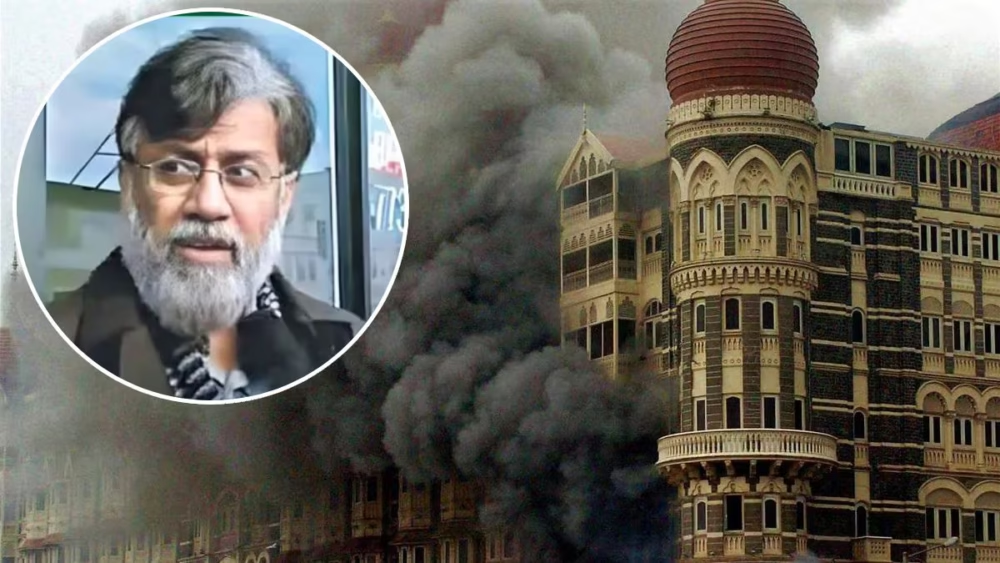
The 26/11 Mumbai terror attacks shook the world. These horrific, coordinated attacks took the lives of countless people and shed a bright light on the world’s counter-terrorism efforts. A central role in this tragic event was played by Pakistani-Canadian businessman Tahawwur Hussain Rana(Tahawwur Rana’s Extradition), who is accused of assisting in the attacks. Recently, new developments regarding his extradition to India have sparked debate among legal and security experts around the world.
Tahawwur Rana’s role in the 26/11 Mumbai attacks
Tahawwur Rana is accused of helping with the logistics and financing of the 2008 Mumbai terror attacks, which killed over 170 people and injured many others. Rana took the help of his friend David Coleman Headley, a Pakistani-American terrorist to scout locations for attacks. Headley had named Rana in his confession, in which he said he used his Chicago-based immigration business for these terror activities.
Rana was arrested in the US in 2009 and convicted in Denmark in 2011 for a separate terror plot, but was acquitted of direct charges in Mumbai. Nevertheless, his alleged indirect involvement remains a matter of dispute between India, Pakistan and the United States.

US Supreme Court rejects Rana’s stay plea
In another new development in this ongoing saga, the US Supreme Court rejected Rana’s “emergency petition for stay pending trial”. Rana had filed the application to avoid his extradition to India, citing potential risks and misappropriation of evidence. The Supreme Court’s decision is significant for several important reasons:
Role of international law: The decision strongly demonstrates a commitment to cooperative extradition agreements, particularly in cases involving terrorism. It also highlights the importance of the India-US Extradition Treaty, which was crucial in this case.
Message to terrorist networks: The approval of extradition sends a strong message that no individual involved in acts related to terrorism should be allowed to escape the reach of justice, no matter how much time has passed.
Precedent for upcoming extraditions: This case sets a precedent for handling high-profile cases involving accused international terrorists and highlights the importance of global cooperation.
Why does Pakistan deny its connection to the 26/11 attacks?
Despite evidence linking the 26/11 attacks to Pakistan-based Lashkar-e-Taiba, Pakistan has denied any links to the Lashkar group, which remains highly active in Pakistan and has faced international sanctions against its leader Hafiz Saeed. Still, Pakistan’s continued denials make it difficult to completely dismantle such networks and raise questions about how Pakistan views its counterterrorism commitments.
Rana’s extradition could raise this question again, increasing pressure on Pakistan to live up to its responsibilities.
Extradition between the US and India: A complex process
Extradition in cases such as Rana’s is not straightforward. The process works as follows:
Formal request and review: India officially requested Rana’s extradition from the US under the India-US Extradition Treaty. The request was thoroughly scrutinised by US authorities, who confirmed that the allegations met the legal requirements.
Court rulings and appeals: Rana has been given every opportunity to appeal his extradition, wherein he can present his case under US law.
Approval by US State Department: Even after the court ruling, final approval rests with the US State Department. The rejection of the stay application by Rana shows that the extradition has strong support at both the judicial and diplomatic levels.
What does India do next?
If Rana is successfully extradited, India will face several legal and political challenges:
- Ensuring that the trial against him is transparent and in accordance with international norms.
- Unravelling further links between Rana, LeT and other international terror networks.
- Facing potential retaliation or diplomatic resistance from Pakistan.
At the same time, India will have to handle the case carefully to prove its commitment to a fair trial and ensure justice for the victims and their families.
Global measures after the 26/11 attacks
The international community reacted strongly after the Mumbai attacks, and many countries revised their counter-terrorism strategies. A notable move was taken by the Financial Action Task Force (FATF), which put Pakistan on the “grey list” for not being effective in curbing terrorist financing. Collaborative counter-terrorism initiatives have also seen a rise, as countries realize that coordinated efforts are necessary to combat global terrorism.
Implications of Rana’s extradition
Rana’s extradition could have several implications on India-Pakistan-US relations:
India-US relations: The approval of the extradition reflects the growing trust and partnership between India and the US in the fight against terrorism.
Pressure on Pakistan: If Rana’s trial exposes deeper links between Pakistan and the attacks, it could further isolate Pakistan on the global stage.
Impact on Lashkar-e-Taiba: A fair trial could provide crucial information about Lashkar’s international operations, which could help broader counterterrorism efforts.
A Case That Goes Beyond Borders
Tahawwur Rana’s Extradition case is not just about one individual it highlights the complex web of international terrorism and the need for global cooperation. It is a reminder that the pain we suffered after 26/11 must never be forgotten and we all have a responsibility to prevent such terrorist incidents from happening again.
Until all those involved in these deadly attacks are brought to justice, Mumbai will not get justice. Rana’s extradition and his upcoming trial could be another important step towards this goal.
Also Read : RBI monetary policy analysis: Focus on new developments
Join Us : Facebook


One thought on “Justice for Mumbai: Tahawwur Rana’s Extradition Fight”